A Time for Famine, A Time to Feast
A Reflection on the 2025 KALI National Gathering
By Daniel Jung
Cigarette butts and memories are like the ocean.
During the summer after my final year of seminary, my family and I moved into the first-floor unit of a two-story apartment complex on the southeast corner of Grand Rapids, MI. The tenants of the Windridge Apartments were a far cry from the sheltered dorm life of seminary housing.
I soon found out that my upstairs neighbor, Jerry, was a habitual smoker and would throw his cigarettes over his balcony and onto the grass in front of our doorway. All summer long, I would pick them up and throw them into a leafy shrub next to our sliding glass door. I told myself I was too busy to throw them away in a proper trash receptacle. This would do for now. Out of sight, out of mind.
Renowned author and theologian Henri Nouwen writes, “Healing is mourning as well as dancing: mourning over losses that the world, captive to the forces of Evil, inflicts on us, and dancing in the house of God where we belong. We tend, however, to stay away from both mourning and dancing: too afraid to cry and too shy to dance. We say, ‘It is not as bad as you think, nor as good as you hope.’”
Mourning the famine. Dancing at the feast. God has appropriated times and seasons for both. But many of us, as Korean American pastors, reject the divine ordinance of both seasons. We dismiss the famine and never fully embrace the feast. Our muted disposition is a learned response. Our cultural and spiritual upbringing necessitated a cautionary hedging of our emotional bets. Life demanded that we don’t dwell too long in any extreme and move on with haste. In short, the price paid for dwelling along the outer margins of our emotions was too costly. Our parents and grandparents were never afforded this luxury and we feel degrees of guilt taking it ourselves.
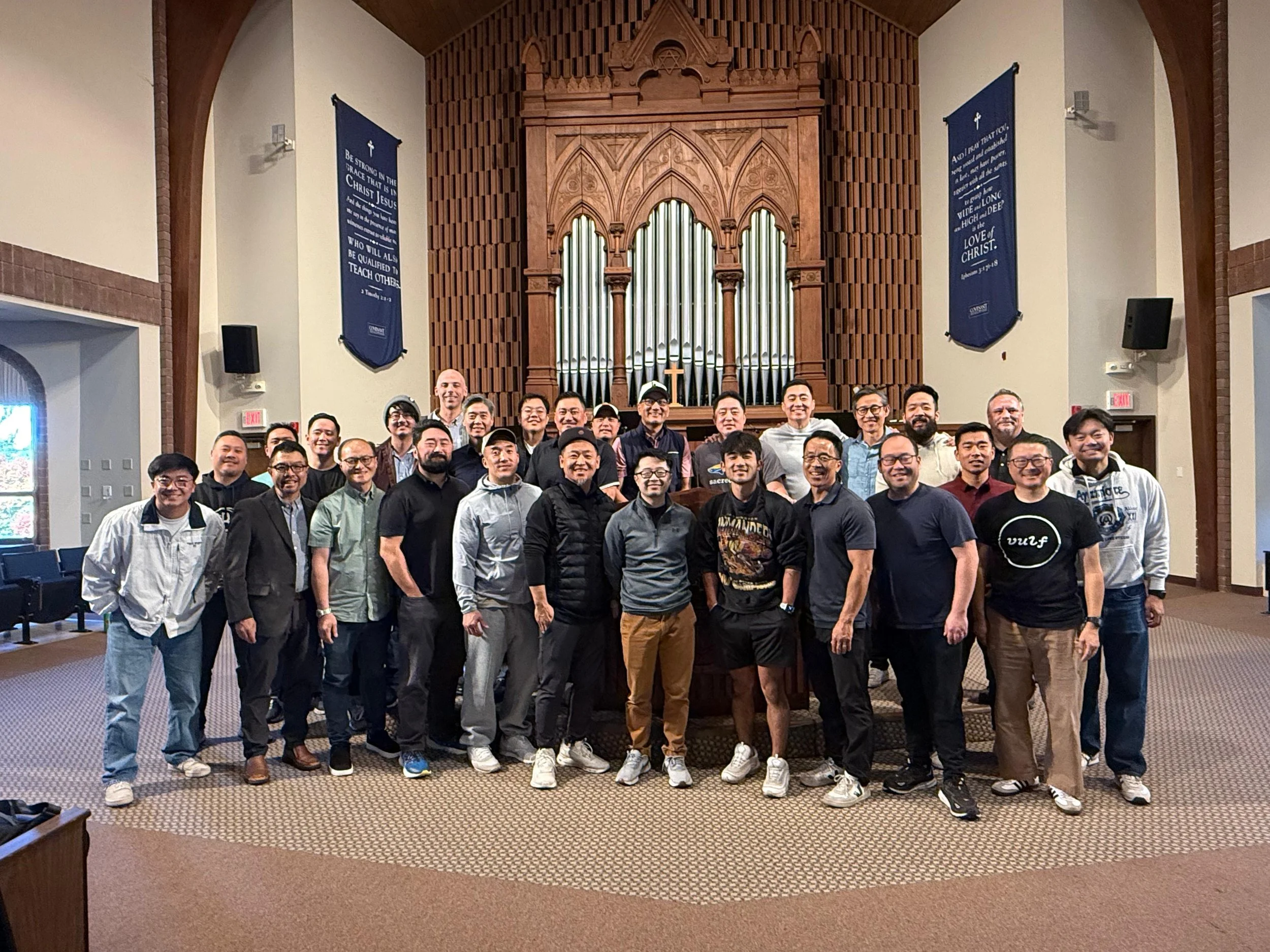
So with the theme of “Nourishing Korean American Pastors for the Flourishing of the PCA”, nearly forty Korean American pastors gathered at Covenant Theological Seminary in St. Louis, MO for the second Korean American Leadership Initiative (KALI) National Gathering. For four days and three nights last November, just as the leaves were beginning to blush, teaching elders from across the country recaptured many of the experiences that made the first KALI National Gathering in 2023 so special—unhurried time, open vulnerability, and genuine friendships.
One of the recurring sentiments from attendees was how quickly the bonds of friendships were formed in the relatively short time we had together. These expedited bonds were the result of recognizing our shared seasons of famine—the doubly shared experience of the toilsome loads we carry and the barely mended fragility of the bags we use to tote them. “I felt comforted knowing that I wasn’t the only one who was broken,” confessed one teaching elder. For those four days, recognizing the opportunity our forebearers never had, we were able to pause life and dwell along the outer edges of feasting and famine. Tears were equally abundant from both pained testimonies and deep belly laughs.
One of the highlights of the gathering was a workshop led by TE Bobby Suh (Christ Central Presbyterian Church) on the topic of “Flourishing Emotionally.” Without divulging too many specifics, Pastor Bobby led us through a teaching that was centered on the gospel and the subsequent healing from despondency that Christ offers to us all. Mixing equal parts personal testimony, keen biblical insight, and hands-in-the-soil ministry expertise, the workshop delineated tangible first-steps toward acknowledging the emotional famine from which we hoped to heal.
Tears were equally abundant from both pained testimonies and deep belly laughs.
The workshop also made it clear that many of us have experienced prolonged seasons of drought but have yet to properly mourn. Out of sight, out of mind. We told ourselves that life moved too fast to dwell in mourning, only to discover that its deferral has resulted in burnout, physical ailments, emotional abuse, moral failures, and altogether unhealthy rhythms of life.
But it was at the National Gathering we acknowledged, many of us for the first time, that in the midst of our famine, we were the cause and the recipient of much heartache. Heartache received and multiplied. Through our groans and weeping, these discoveries were met with lament and repentance.
It’s been a couple of months since the gathering and as Korean American pastors in the PCA, I believe God is in the process of bringing us to the threshold of a major crossroad, preparing us to exit the winter famine and inviting us to embrace a spring feast. Repeated events like the KALI National Gathering have been instrumental in acknowledging our need to mourn the season we’ve just endured with the hope that as we learn to mourn the famine, we may also learn how to dance at the feast.
After a few summer months, the long and humid West Michigan days dissipated and rapidly gave way to frigid chills, the dreaded first-snow of that year falling just before Halloween. All the leaves quickly went from a slight blush, to a full Autumn bloom, then a hasty plummet to the earth.
When winter arrived at the Windridge Apartments, the bush in front of our patio lost its leaves and to my horror (and my wife’s dismay), we saw the full remnants of my neglect. All of Jerry’s cigarette butts were still there—hundreds of them scattered around the roots of the barren bush—a stark reminder of neglected duties no longer out of mind and certainly not out of sight.
My therapist once told me that our minds are like the ocean. Nothing really ever vanishes. Things may seem to disappear but they don’t. They just sink to the bottom and stay out of sight, but it’s always there. Taking up space in the depths and darkness.
As Korean American pastors, along with preaching well, leading our teams with efficiency, and casting long-term vision for our churches, taking the time to deal with the cigarette butts that have been discarded into the ocean of our minds may be our most important priority as we move into the next season of life and ministry.

Daniel Jung is a graduate of Calvin Theological Seminary and a teaching elder in the Korean Northwest Presbytery. He lives in Northern California, where he serves as an associate pastor at Home of Christ in Cupertino. In his spare time, Daniel loves the 49ers, good coffee, and writing about the intersection between faith and pop-culture. You can find more of his work here.
If you found value in this content and believe in the ministry of KALI, we ask that you prayerfully consider participating with us through your financial support. You can make a tax-deductible contribution to this ministry online. Clicking on this link will direct you to KALI’s MNA (Mission to North America) giving page. Please follow the website’s instructions from there.